


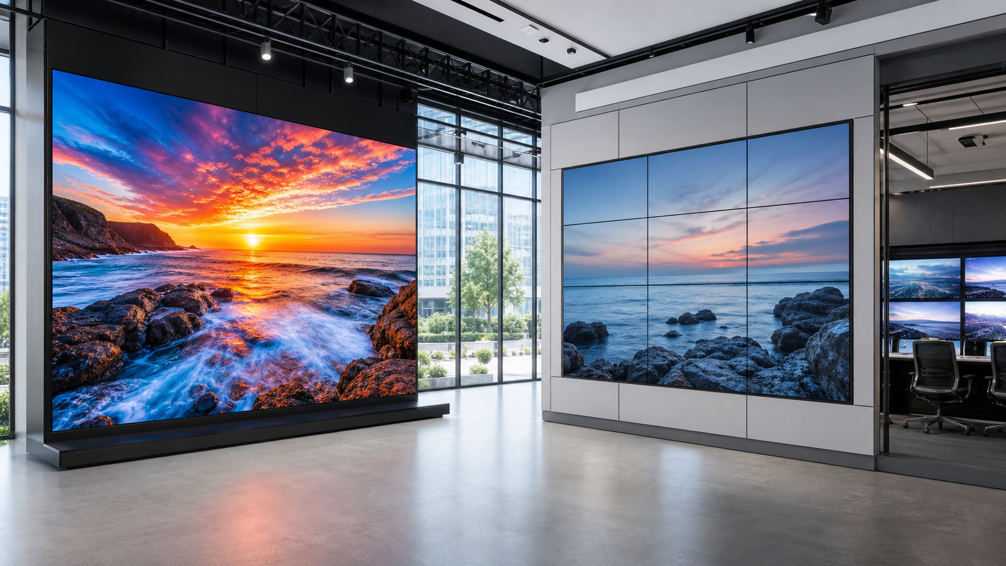
Direct-view LED is the better choice for commercial display projects with large screens, daylight environments, or long daily operation. It outperforms LCD on brightness, scaling, weather durability, and ten-year operating cost. LCD remains practical for desktop monitors, indoor menu boards, and small conference room screens. The confusion across the industry comes from the term LED itself, which means two different things depending on whether you are buying a consumer TV or a commercial video wall.
How LCD and LED Displays Work
LCD and direct-view LED solve the same problem with different physics. One modulates a separate light source. The other generates light at the pixel.
How LCD Works
An LCD works like a sheet of tiny window blinds placed in front of a lamp. The lamp is the backlight. The blinds are millions of liquid crystal subpixels that twist open or shut to let light through. Color filters in front add red, green, and blue, the way colored gels color a stage light.
The backlight never fully switches off while the screen is on. That is why LCD blacks look grey under bright lighting. Even when a blind is fully shut, some backlight still leaks through.
Most modern LCDs already use small LEDs as the backlight, which is what retailers call "LED TV." This is the first source of LCD vs LED confusion. The screen is still an LCD. Only the bulb behind it has changed.
Panel type then controls how fast the pixels move and how stable the colors look from the side. Twisted nematic (TN) is the fastest, but it shifts color at an angle. In-plane switching (IPS) holds color from any angle but reacts slightly slower. Vertical alignment (VA) sits between them.
How Direct-View LED Works
Direct-view LED removes the lamp entirely. Every pixel is its own tiny light source. Red, green, and blue LEDs sit together as one pixel, switching through every brightness level to create the image.
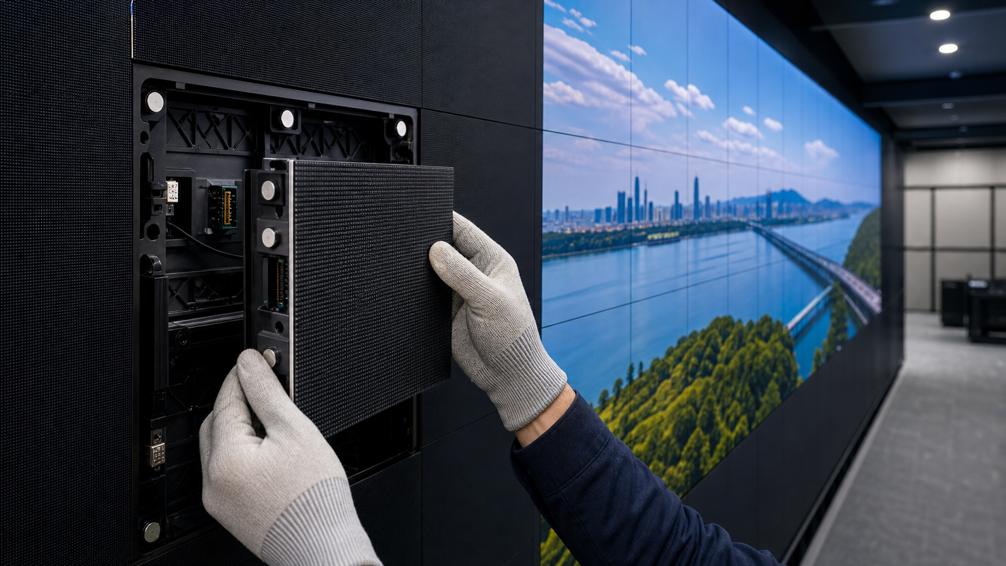
Each LED cluster sits on a module about the size of a paperback book. Modules lock into cabinets that fix into walls of any size or shape. An outdoor billboard or a curved indoor lobby screen is built from the same kind of building blocks.
You may see two packaging terms on spec sheets. SMD soldiers each have red, green, and blue LEDs on the panel as a separate package. COB seals them inside the same protective layer that is more rugged and easier to clean. SMD is more common at higher resolutions; COB is preferred where the screen will be touched or rinsed.
Pixel pitch describes how tightly those pixels are packed. P2.5 means 2.5 millimeters between pixel centers. A rough rule is that the minimum comfortable viewing distance in meters matches the pitch number, so P3 looks sharp from three meters back and P1.5 from one and a half. If you are sizing a wall for a real project, the LED wall calculator helps translate room dimensions and viewing distance into a practical screen size before you narrow down LCD vs LED.
LCD vs LED Performance Comparison
Brightness, lifespan, energy draw, and total cost decide most commercial display purchases. The gap between LCD and direct-view LED on these metrics is wide, and the cost picture extends well past the hardware quote.
| Spec | LCD | LED |
|---|---|---|
| Light source | CCFL or LED backlight | Self-emissive RGB diodes |
| Indoor brightness | 300 to 700 nits | 800 to 2,500 nits |
| Outdoor brightness | Below 1,000 nits | 5,500 to 8,500 cd/m² |
| Operational lifespan | 5 to 7 years under heavy use | Over 100,000 hours, modular replacement |
| Pixel pitch | Fixed by panel | P0.7 to P20, fully modular |
| Seamless scaling | Visible bezels between tiles | No seams between modules |
| Outdoor protection | Limited, panel-dependent | IP65 standard outdoor |
| Upfront cost | Lower at small sizes | Higher per square meter for fine pitch |
| Energy use at 10+ hours daily | Constant backlight draw | Pixel-level draw, lower with dark content |
| Maintenance access | Full panel swap typical | Module-level swap, front or rear access |
| Best applications | Monitors, indoor menus | Video walls, billboards, stadiums, and control rooms |
Brightness Output
Direct sunlight needs at least 5,000 nits to keep an image readable.
LCD signage caps below 1,000 nits, which is why a window-mounted LCD goes nearly black against an afternoon sun.
Outdoor LED cabinets push 5,500 to 8,500 cd/m², comfortably above the daylight threshold.
Lifespan and Service
The U.S. Department of Energy notes that LED light sources are expected to deliver a useful life of 30,000 to 50,000 hours before output drops below 70 percent of original, with commercial LED display assemblies typically rated longer. LCD backlights age earlier.
Module-level service on LED also removes the need to replace a full panel when one section fails, which extends usable service life on large installations.
Energy Consumption
LCD runs its backlight at full power whenever the screen is on, even when the image is mostly black. But LED only powers the pixels that are actually lit. An LCD video wall and a comparable LED wall can show a 30 to 50 percent gap in power draw over a year.
On a screen running 12 hours a day, energy savings often pay back the higher LED hardware cost within three to four years.
LCD and LED Strengths
LCD and LED each offer specific strengths that fit different display environments. Brightness range, screen size, viewing distance, and daily operating hours decide which technology fits a given project.
Where LCD Excels
LCD wins at small sizes in price. A 32-inch 1080p LCD monitor sells for under $200. A direct-view LED of similar pixel density costs roughly ten times that.
Pixel density is the other strength. Smartphone LCDs commonly run above 400 pixels per inch. Tablets and laptops sit at 220 to 300. Direct-view LED cannot reach those densities at consumer prices, which is why no LED smartphone exists.
Indoor environments with controlled lighting also favor LCD. A 250 to 500 nit LCD is plenty for a hotel directory, or a conference room screen, where the viewer sits within three meters, and the room lights stay moderate.
Professional IPS LCD monitors cover more than 99 percent of the sRGB color range and 90 percent of DCI-P3, which means they can show nearly all the colors used in design, photo, and video work. Color-critical editing rooms still specify LCD for this reason.
Where LED Excels
LED produces light at every pixel, and that single fact is why LED delivers true black and contrast that LCD cannot match. A black pixel is just an LED that is off, with no backlight leaking through.
Outdoor LED cabinets run 5,500 to 8,500 cd/m² without color shift. LCD plateaus below daylight readability, which is why almost every major outdoor signage project has switched to LED.
Scale is the other LED advantage. A single project can mix pixel pitches across viewing zones, build curved or transparent surfaces, and grow from a 4-square-meter preview screen to a 1,000-square-meter video wall using the same cabinet system. No LCD architecture can do this.
Service works the same way as a scale. Failed modules can be swapped from the front or back in minutes, without taking the wall offline. That is what makes 100,000-hour lifespans real, because the wall is repaired piece by piece rather than replaced as one unit.
LCD and LED Market Trends
LCD still dominates by share. Grand View Research estimated that LCD held 37.7 percent of the global electronic display market in 2023, driven by smartphones, tablets, and TVs, where pixel density and unit cost matter most.
As the commercial venues replace LCD video walls and projection systems, the global outdoor LED display market reached USD 7.24 billion in 2022 and is projected to reach USD 23.38 billion by 2030 at a 15.9 percent compound annual growth rate.
Display Selection by Use Case
Room conditions decide the technology choice faster than spec sheets. Outdoor projects need different cabinets than control rooms, and rental rigs need different cabinets than fixed installations.
Outdoor Advertising and Stadiums
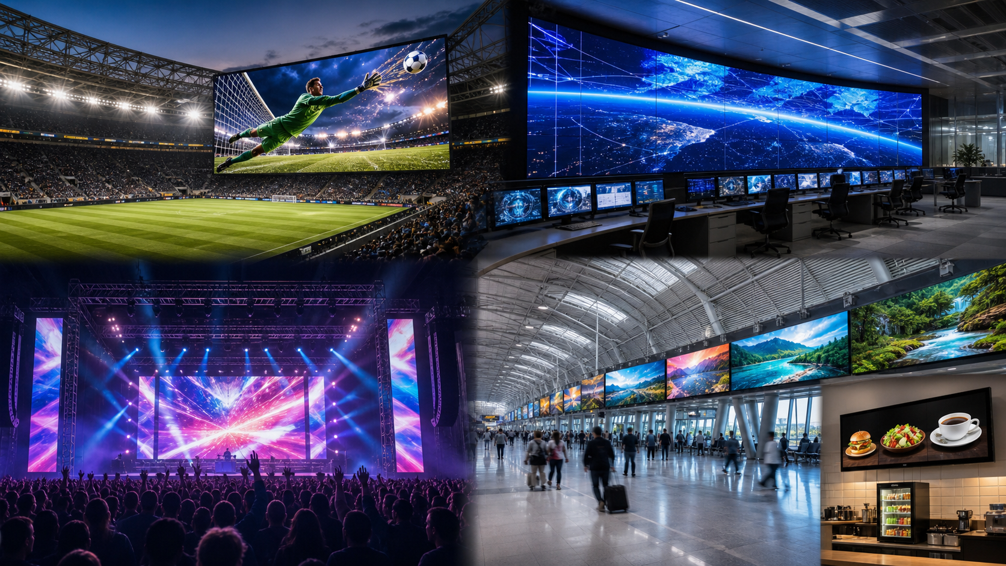
Outdoor advertising and stadium signage demand high brightness, IP65 protection, and reinforced cabinet structures. A purpose-built outdoor stadium fixed LED display provides the wide viewing angle and sustained brightness needed under floodlight or daylight conditions.
Indoor Video Walls and Control Rooms
Control rooms running 24/7 mission-critical operations need pixel pitches under P1.5 to deliver readable detail at close viewing distances. They also cannot tolerate visible seams between display units, which immediately rules out tiled LCD walls.
MarkWide Research reports that direct-view LED systems are now compressing pixel pitches below 1mm for indoor applications, putting LED into the territory LCD video walls used to dominate. Esdlumen's VPQ P2.5 fine-pitch installation at the Guizhou Command Center is one working reference, running continuous regional-control visualization across a seamless wall.
For projects targeting 4K or 8K continuous imagery, a 5G fine-pitch LED display series handles the resolution at viewing distances as close as one meter.
Rental and Event Staging
Concert tours, trade show exhibitions, and corporate events run on LED rental systems that can come down and roll out again within hours. Lightweight modular cabinets such as the Pilot Pro fine-pitch rental display handle fast setup, mixed-shape splicing, and front-access service when something fails mid-show.
Beyond panel-level features, integrators need rugged rental and staging LED systems for cabinet locking, signal redundancy, and shock absorption that touring rigs demand.
Esdlumen's Dazzle Plus P7.8 deployment at a concert in Tokyo is one example of touring-grade panels operating in transport and rigging conditions that LCD assemblies cannot physically tolerate.
Transportation Hubs
Transportation hubs combine both technologies. Departure boards and gate signs use LCD where viewing distance stays under three meters, while atrium video walls and long-distance overhead boards switch to LED for visibility at fifteen meters or more.
Transit-grade rollouts use IP-rated cabinets and signal redundancy, which a transportation LED display solution addresses end-to-end.
Virtual Production and Film Studios
Virtual production replaces traditional green screens with LED walls. The actors stand in front of a large LED panel that displays the background scene live, and the camera films the actors and the LED background together. There is no compositing or green-screen replacement later.
For this to work, the LED panel must refresh much faster than the camera shutter, or the footage shows horizontal banding. Anything below roughly 3,840 Hz risks visible scan lines on screen.
The AIE Virtual Production studio in Australia runs on LED panels because LCD cannot deliver the brightness uniformity and refresh-rate stability that in-camera shooting requires, especially at the 3,840Hz and above range that prevents visible scan lines on filmed footage.
Indoor Menu Boards and Personal Monitors
Indoor menu boards, hotel signage, and personal monitors still favor LCD on unit cost and packaged size. A 55-inch commercial LCD remains the practical pick for a single-screen wall menu or hotel directory.
FAQs
Is an LED TV the same as a direct-view LED display?
No. LED TVs are LCD panels with LED backlighting. Direct-view LED displays generate light at each pixel without an LCD layer. The two categories share the term LED but serve different applications, with direct-view LED used for video walls and large signage.
Which display works better outdoors, LCD or LED?
LED works better outdoors. Outdoor LED cabinets reach 5,500 nits and above with IP65 weather sealing. LCD panels rarely exceed 1,000 nits and lack the sealed enclosures needed for sustained outdoor use in rain, dust, or heat.
How long does a commercial LED display last?
Commonly above 100,000 hours of operation. Modular construction extends usable service life since individual modules can be replaced without removing the full installation, which is not possible on a sealed LCD video wall.
Is LED more energy-efficient than LCD at large screen sizes?
Yes. LED only powers pixels that are lit, while LCD runs a full backlight whenever the screen is on. The savings scale with screen size and daily operating hours, which is why large outdoor installations have moved to LED.
Can fine-pitch LED match LCD in close-viewing detail?
Yes. Fine-pitch LED below P1.5 produces sharp images at viewing distances of one to two meters. This puts LED into the same close-view applications that LCD historically owned, including command center video walls, broadcast studios, and retail brand experiences.
Why is the direct-view LED display market growth outpacing LCD?
It is replacing projection and LCD video walls in commercial venues. Grand View Research projects the outdoor LED display segment to roughly triple between 2023 and 2030, with stadium, retail, and transportation deployments driving most of the increase.
Summary
The LCD vs LED question is mostly settled at the commercial scale. Direct-view LED delivers higher brightness, longer service life, IP-rated weather protection, and modular scaling LCD cannot match.
LCD still holds value for personal monitors, small meeting room screens, and indoor menu boards, where unit price and pixel density at small sizes work in its favor.
Specifying the right cabinet, pixel pitch, and protection rating is where most project risk lives.
Manufacturers like Esdlumen, with documented deployments across command centers, broadcast studios, stadium boards, and touring concerts, can advise on engineering choices that protect long-term project economics.


