


Curved LED screens can be built using flexible modules mounted to shaped support structures, adjustable cabinet systems, or a combination of both. A tight architectural curve, a suspended installation, and a screen designed for repeated assembly each place different demands on the supporting structure, connections, and on-site installation work.
How Do Flexible Modules and Angle-Adjustable Cabinets Work?
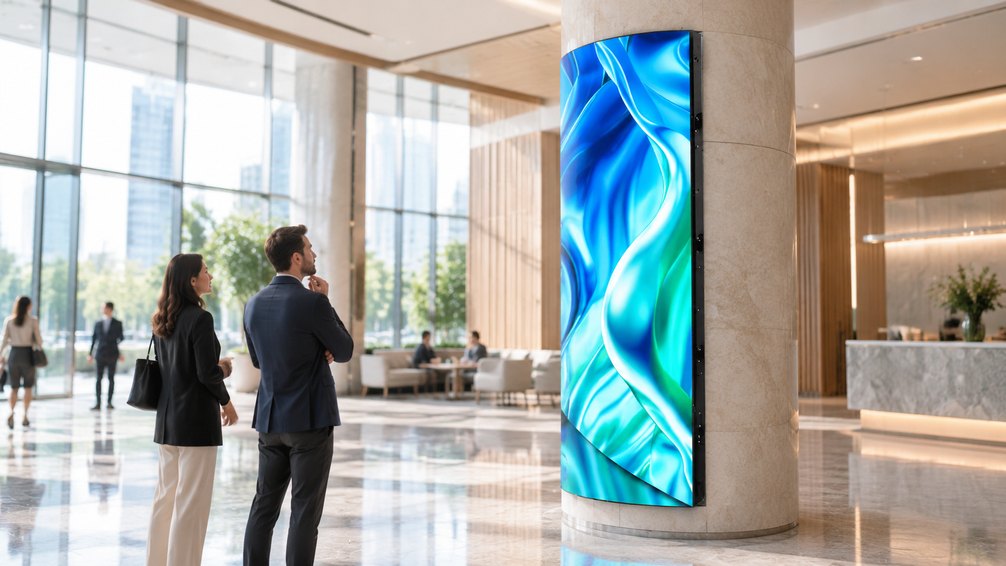
Flexible modules bend along a shaped support structure to create the required curved surface. Our BIM MIN Series combines flexible modules with curved cabinet structures, allowing the display to follow rounded columns and irregular architectural surfaces in commercial installations.
Adjustable cabinet systems create curved surfaces through mechanical angle adjustments, either within individual cabinets or between adjacent panels, depending on the product design. Our E-Swan Series (Indoor) is designed for flexible curved configurations in rental applications, featuring an adjustable cabinet structure that allows individual panels to bend into different curved shapes. This makes it suitable for stage designs and event installations that require varied screen layouts.
Shape and Curvature: How Do the Two Build Methods Compare?
Both flexible modules and angle-adjustable cabinets can form concave, convex, and cylindrical LED displays. Their achievable shapes depend on different structural limits. Flexible modules follow the contours of a support frame within their permitted bending range, while angle-adjustable cabinets form curves through the available connection angles and panel arrangements. The required radius, total arc angle, and display dimensions determine whether either method can achieve the intended shape.
The E-Swan Series (Indoor) shows how adjustable connection angles control the shape of a curved LED display. Its nine adjustment settings and bending capability of up to 45 degrees per 500 × 500 mm panel allow the screen to form waves, cylinders, and concave or convex curves. At SLS Expo 2025, we demonstrated a cylindrical E-Swan display built with eight panels, achieving a minimum diameter of 1.27 meters in that configuration.
Complex curved geometries can also be achieved by combining different display structures within one installation. At SLS Expo 2024 in Saudi Arabia, we combined BIM Plus-X and BIM MIN to create a suspended, irregularly curved pillar display. In this installation, BIM MIN formed the curved sections, while BIM Plus-X enabled mixed splicing with other display sections, allowing the suspended structure to combine different geometries.
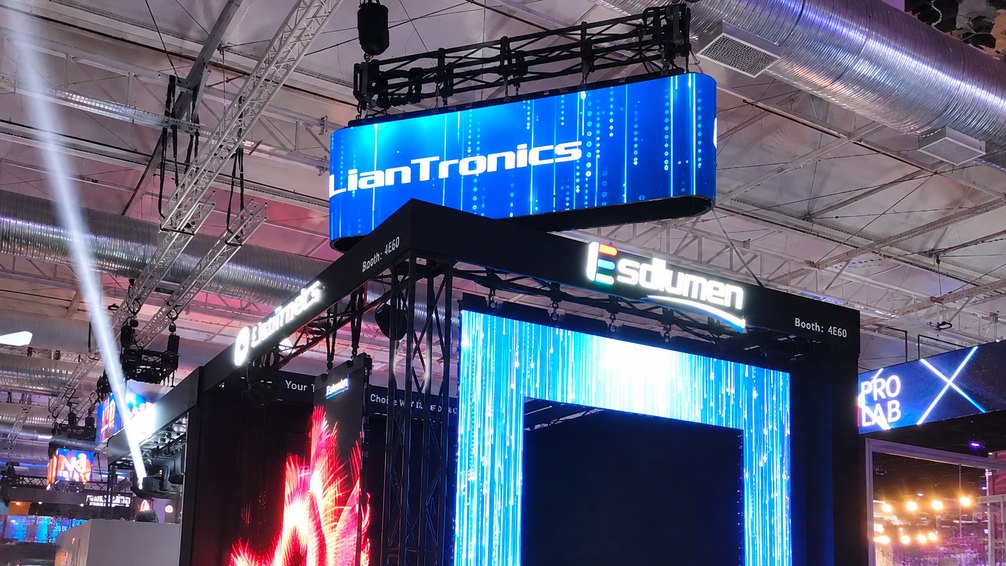
Image Quality: What Affects the Final Curved Display?
The image quality of a curved LED screen depends on pixel pitch, viewing distance, color calibration, contrast, surface smoothness, and visible seams. Pixel pitch and viewing distance affect how clearly viewers can see image details, while calibration and contrast influence color consistency and the distinction between bright and dark areas. Uneven surfaces can distort the appearance of straight lines and graphics across the curve, while gaps between modules or cabinets can create visible breaks in the image.
Both construction methods can deliver comparable image sharpness at the same pixel pitch and viewing distance. Their differences in surface smoothness and seam visibility are outlined below.
| Curved Display Factor | Flexible Modules | Angle-Adjustable Cabinets |
|---|---|---|
| Surface smoothness | Modules follow the curved frame to form a continuous arc | Surface continuity depends on the cabinet bending mechanism and connection design; bendable cabinets can form smooth curves, while rigid cabinets may create segmented arcs |
| Visible seams | Module gaps follow the curved surface | Seam visibility depends on cabinet alignment, joint design, and adjustment precision |
| Image sharpness | Fine-pitch options support close viewing | Comparable image detail can be achieved with equivalent pixel pitch, display specifications, and calibration quality |
Installation and Maintenance: What Changes with Each Build Method?
Installation work differs between the two methods. Flexible modules typically require a shaped support frame, individual module fitting, and on-site wiring. Angle-adjustable cabinets use panel connections that can be set to the required angles, making them practical for repeated assembly and dismantling. The installation workload varies with the mounting structure and project layout.
Maintenance requirements vary with module access, cabinet connections, and available service space. Our BIM MIN Series combines flexible modules with curved cabinet structures and supports full front maintenance, allowing technicians to reach components from the front. Its standard 42 mm cabinet depth suits installations with limited rear service clearance.
Cost Comparison: What Determines the Total Project Budget?
The total project budget for a curved LED screen is determined by the LED hardware, screen size and pixel pitch, supporting structure, installation, processing equipment, transport, and ongoing maintenance. The required curvature also affects structural costs, especially when the display needs custom framing or additional on-site fitting.
Flexible modules may require custom-shaped support frames, while angle-adjustable cabinets can use standard panel connections when their available angles match the design. For rental projects, transport, repeated assembly, and panel reuse add further cost considerations. A fair comparison should use the same display dimensions, brightness, viewing distance, and image-performance requirements, with separate estimates for hardware, structural fabrication, installation, and ongoing service.
How to Choose the Right Build Method for Your Curved LED Screen
The right construction method depends on the required shape, curvature, supporting structure, and installation conditions. Both approaches can create curved LED displays, but their suitability depends on whether the specific module or cabinet configuration meets the project requirements.
- Retail columns and irregular architectural features: Flexible modules can follow custom contours within their supported bending range, while angle-adjustable configurations are also possible when the panel geometry matches the surface.
- Permanent curved walls and exhibitions: Maintenance access becomes a practical consideration once the display is installed close to a wall. Our BIM MIN Series provides full front maintenance, reducing the need for rear service clearance. The required curve and supporting structure still determine the suitable configuration.
- Stage productions and changing layouts: A single set of adjustable panels can be assembled into different curved layouts for successive events. Our E-Swan Series (Indoor) offers this flexibility through its adjustable connections, making it suitable for changing stage designs.
- Large curved event backdrops: The overall arc must be achievable with the selected panel dimensions and connection angles. Angle-adjustable cabinets can form broad curved backdrops within their supported configurations, while more irregular designs may call for flexible modules or a combined structure.
FAQs
Can a flexible LED screen be used outdoors?
Yes. Flexible LED screens can be used outdoors when they have suitable weather protection and brightness. Our E-Swan Outdoor ES3.9T features front IP65 protection, with 5,000 nits for the White variant and 3,500 nits for the Black variant. The IP rating follows IEC 60529, which classifies degrees of protection against dust and water ingress. These specifications provide options for different outdoor lighting conditions.
Does a curved screen need a special video format?
No. Curved LED screens generally support standard video formats. The content resolution should match the display's pixel dimensions, while the layout needs to account for the screen's shape. For cylindrical displays, text and logos should remain readable from different viewing directions. Wide curved backdrops can use content layouts designed for the audience's main viewing positions.
Can an existing flat LED screen be converted into a curved display?
It depends on the original screen's module and cabinet design. Cabinets with compatible angle-adjustable connections may be reconfigured into a curved display. Standard rigid cabinets with fixed connections generally cannot form a curve without replacing or modifying structural components. The existing screen's mechanical connections and mounting structure determine whether conversion is feasible.
Conclusion
Curved LED screens can be constructed with flexible modules, angle-adjustable cabinets, or a combination of different display structures. The final configuration depends on the required geometry, mechanical design, installation conditions, and maintenance needs.
At Esdlumen, we provide curved LED screen solutions for permanent commercial installations and rental applications. If you're planning a curved LED project, contact our team with your proposed screen dimensions, target radius or diameter, installation drawings, and intended application. We can review the requirements and help identify a suitable flexible-module, angle-adjustable cabinet, or combined configuration.


